
Resources For Leadership
Featured
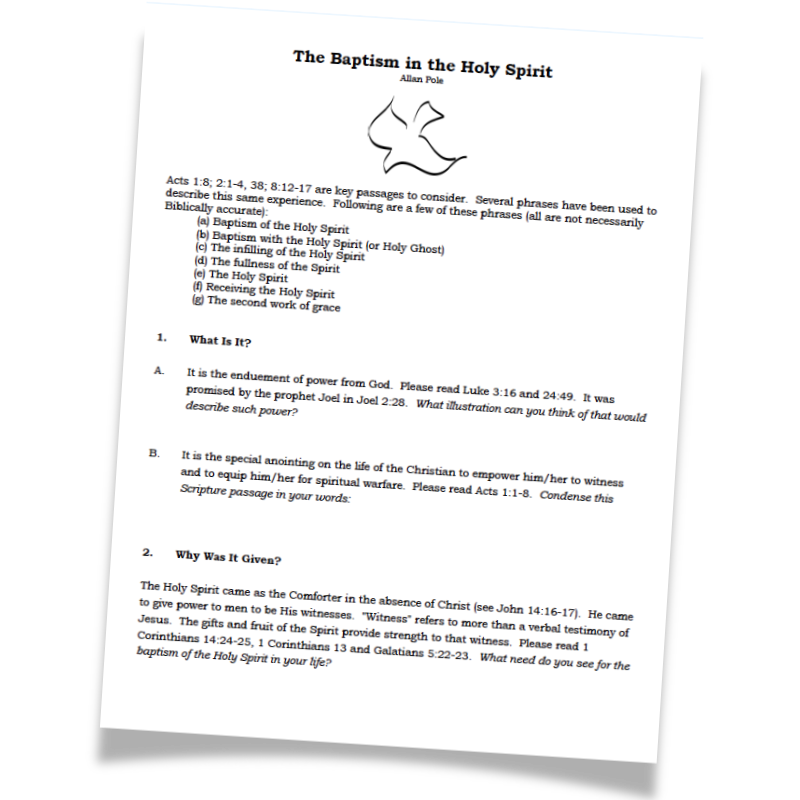

A straightforward guide to the Baptism in the Holy Spirit, covering what it is, why it was given, how it relates to salvation, its signs, and its ongoing role in empowering believers for witness, ministry, and spiritual warfare.
Drawing from God’s pattern of calling leaders, this message shows how His direction often requires a reordering of our location, our spiritual condition, and our priorities. Accepting God’s call touches time, talents, and resources, and often presses against personal comfort. True leadership begins with surrendering to God’s rearranging work so His purposes can take root.
This session explores the core character of a biblical leader and the posture needed to carry influence well. Through Scripture and practical insight, the teaching highlights humility, repentance, dependence on the Holy Spirit, and a willingness to be formed by God before being used by Him. Leadership is framed not as position, but as the overflow of a life shaped by Christ.
Philippians 1:1 - Blueprint for the church
Main scriptures: Phil 1:1-2, Acts 6:1-7, 20:28-32, 1 Pet 5:1-4
This session explains the foundational role apostles and prophets play in establishing healthy churches. Their gifts help set direction, guard doctrine, strengthen unity, and create environments where the rest of the ministry gifts can function as God intended.
Here the focus turns to how apostles, prophets, evangelists, pastors, and teachers work together to equip the church. Each gift contributes something distinct, and the church matures when all are present, recognized, and allowed to function as Christ designed.
This session highlights the pastoral and teaching gifts, showing how they build stability, clarity, and care within the church. Shepherds nurture and guide people through life, while teachers ground the community in truth so it can grow with confidence.
This session brings the series together by showing how every believer has a part in the work of ministry. When leaders equip the church and people step into their God-given roles, the whole body grows stronger, healthier, and more effective in fulfilling Christ’s mission.
Explore how Scripture frames leadership as a calling rooted in character, service, and Spirit-empowered gifting.
An an apostolic-prophetic model of church leadership built on organic life, servant-hearted character, and New Testament patterns.
A practical framework for church leaders who want to invest in people, develop high-capacity teams, and form sons and daughters in the faith who can carry ministry further than the previous generation.
Paul turns to sanctification in Romans 6, describing how believers learn to walk in the new life God provides. This session explains the contrast between old habits and new identity, the call to present ourselves to God, and how the Spirit enables obedience.
This session examines Romans 9–11 and Paul’s teaching on Israel and the Gentiles. It explores election, mercy, Israel’s calling, and God’s ongoing faithfulness to His promises. The teaching shows how God’s plan includes all nations without abandoning Israel’s role in His story.
Romans 9 highlights God’s sovereignty and compassion. This session explains how God’s purposes stand even when people resist Him and how His mercy extends beyond Israel to the Gentiles.
Romans 12–13 describe the practical outworking of the gospel. This session explains presenting ourselves to God, using gifts within the church, living with Christian character, and relating to governing authorities. Love becomes the fulfillment of the law.
An overview of the world between Malachi and Matthew, tracing how empires rose and fell, cultures collided, and Israel lived through centuries of upheaval and longing. This session shows how Persian policy, Greek influence, Maccabean revolt, and Roman rule shaped the world Jesus would enter, revealing why the Gospels unfold the way they do and why Israel’s anticipation for a Messiah burned so intensely.
Walking through the opening movements of Jesus’ story — the formation of the Gospels, the significance of His genealogies, the miracle of His birth, and the deep messianic hunger that shaped Israel in the first century. From the announcement to Mary, to Simeon and Anna’s prophetic recognition, to the visit of the magi and Herod’s violent response, these readings reveal a world longing for deliverance and a Messiah arriving in ways no one expected. The session also traces the early ministry of John the Baptist, the baptism and temptation of Jesus, the calling of His first disciples, the wedding at Cana, the cleansing of the temple, and Jesus’ profound encounters with Nicodemus and the Samaritan woman. Across every scene, the authority of Jesus rises, the activity of the Spirit is unmistakable, and the expectation of the Kingdom grows clearer.
The early days of Jesus’ public ministry move to center stage: His announcement of the Kingdom, His rejection in Nazareth, the calling of His first disciples, His confrontations with the demonic, and the explosion of healings that follow Him everywhere. This session highlights the authority Jesus carries, the tension it creates, and the growing recognition that Israel’s long-awaited Messiah may finally have arrived.
Growing crowds, growing opposition, and growing revelation shape this portion of the story. Jesus heals the blind and mute, teaches in parables, exposes the emptiness of religious posturing, and describes a Kingdom that upends expectations. This session shows both rising belief and rising hostility as Jesus’ identity becomes harder for the religious elite to dismiss.
The Gospels slow down as Jesus turns His attention to the end of the age, the coming judgment, and the hope of His return. Apocalyptic teaching, warnings to stay watchful, and parables about readiness give shape to a sober but hope-filled vision of what lies ahead. As Jesus shares His final meal, prays for His disciples, and speaks of the Spirit’s coming, the weight of His mission becomes unmistakably clear.
These readings move from Gethsemane to the cross with heartbreaking clarity. Jesus wrestles in agony, willingly submits to arrest, endures betrayal, denial, and corruption at every level of power, and ultimately walks the road toward crucifixion with full knowledge of what it will cost. Yet woven through the darkness is unshakable purpose—Scripture fulfilled, the enemy defeated, and the path opened for resurrection and new creation.
An invitation to step into the story of a movement that began with a handful of ordinary people and grew into a force that reshaped history. The introduction traces the sweep of the book of Acts, the spread of the gospel through the Roman world, and the remarkable way God used both miracles and messiness to build His church. Listeners are reminded that the same Spirit who empowered the first believers continues His work today, calling the church to live with courage, unity, and unwavering devotion to Jesus.
The strength of the believer begins with a clear vision of Christ. This teaching lifts the veil on Jesus’ unmatched supremacy over creation, the spiritual realm, and every power of darkness. Far from a struggle between equal forces, spiritual warfare is rooted in the victory, authority, and preeminence of Christ, who holds all things together and rules as the exalted King. As believers grasp the greatness of Jesus, confidence rises and fear loses its hold.
Understanding the enemy’s character and strategies helps believers stand with wisdom and discernment. Scripture reveals Satan as a created, limited, and fallen being whose goals are to oppose God’s work, gain influence where he can, and distort truth through temptation, accusation, intimidation, and deception. This message exposes his tactics while keeping the focus on God’s greater power, reminding believers that awareness is not fear but preparation for victory.
Spiritual battles are fought best when believers know who they are and whose they are. This session unpacks the rich truths of salvation: being rescued from darkness, redeemed through Christ’s blood, forgiven, made new, adopted, reconciled, empowered, and sealed by the Spirit. These realities dismantle the enemy’s lies and establish believers in confidence, gratitude, and freedom. Identity becomes not an idea but a place to stand.
Victory in spiritual warfare comes through humility, dependence on God, and the daily choice to “put on” the armour He provides. This message walks through the pieces of the armour of God, showing how truth, righteousness, peace, faith, salvation, and the Word work together to defend, steady, and strengthen believers. Woven through the teaching is the reminder that we fight not in our own strength but in the Lord’s, clothed with what He supplies and grounded in His grace.
Spiritual battles are fought safely and effectively when believers understand the boundaries God has assigned to them. This message explores the biblical idea of “sphere of authority,” showing how stepping beyond God-given influence can open the door to harm, while walking within His assignment brings protection, clarity, and power. Through Scripture and practical examples, Allan urges believers to discern where God has positioned them and to operate with humility, obedience, and spiritual attentiveness.
Prayer becomes a place of rest rather than striving when believers learn to trust God’s promises and lean into the Spirit’s help. This teaching weaves Scripture with personal testimony, revealing how intercession, worship, perseverance, and even the gift of tongues strengthen believers for spiritual battle. As hearts draw near to God, prayer shifts from emotional effort to Spirit-led partnership, anchoring believers in His presence and releasing His power.
Text: Luke 6:37-42
What we get out of life depends upon what we put into it.