
A Changed Life | The Book of Daniel | Week 9
Series: The Book of Daniel | Week 9
Text: Daniel 8:1-27
God wants to meet with us and change us forever.
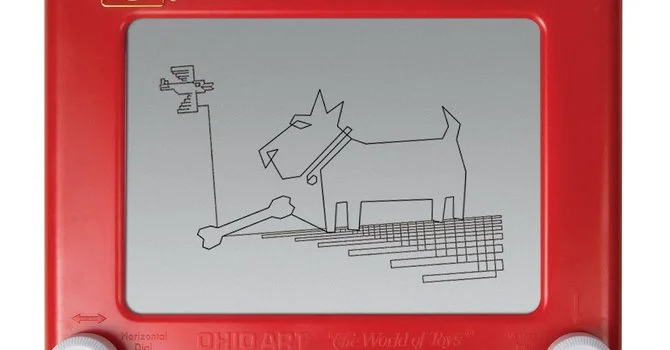
In Daniel 8, the Lord shakes Daniel with a vision—enough to leave him sick for days—so that revelation will lead to repentance and intercession, not notoriety. Like an Etch A Sketch, God overturns our neatly arranged “ducks” so He can redraw our lives according to His purpose; our part is response—humble obedience that returns to everyday faithfulness “about the king’s business,” even as heaven has gripped our hearts.
Here’s a thought: God shakes us up so He can put us together again.
Etch A Sketch is a mechanical drawing toy invented by André Cassagnes of France and subsequently manufactured by the Ohio Art Company and now owned by Spin Master of Toronto, Ontario.
An Etch A Sketch has a thick, flat gray screen in a red plastic frame. The inside surface of the glass screen is coated with aluminum powder, which is then scraped off by a movable stylus, leaving a dark line on the light gray screen. The stylus is controlled by two large knobs, one of which moves it vertically and the other horizontally. Turning both knobs simultaneously makes diagonal lines. To erase the picture, the user turns the toy upside down and shakes it. Doing this causes polystyrene beads to smooth out and re-coat the inside surface of the screen with aluminum powder. The “black” line merely exposes the darkness inside the toy.
The Etch A Sketch was introduced near the peak of the Baby Boom on July 12th, 1960, for $2.99. It went on to sell 600,000 units that year and is one of the best-known toys of that era. In 1998, it was inducted into the National Toy Hall of Fame at The Strong [National Museum of Play] in Rochester, New York. In 2003, the Toy Industry Association named Etch A Sketch one of the 100 most memorable toys of the 20th century. The Etch A Sketch has since sold over 100 million units worldwide.
Daniel 8:1-27:
1 In the third year of King Belshazzar’s reign, I, Daniel, had a vision, after the one that had already appeared to me. 2 In my vision I saw myself in the citadel of Susa in the province of Elam; in the vision I was beside the Ulai Canal. 3 I looked up, and there before me was a ram with two horns, standing beside the canal, and the horns were long. One of the horns was longer than the other but grew up later. 4 I watched the ram as he charged toward the west and the north and the south. No animal could stand against him, and none could rescue from his power. He did as he pleased and became great. 5 As I was thinking about this, suddenly a goat with a prominent horn between his eyes came from the west, crossing the whole earth without touching the ground. 6 He came toward the two-horned ram I had seen standing beside the canal and charged at him in great rage. 7 I saw him attack the ram furiously, striking the ram and shattering his two horns. The ram was powerless to stand against him; the goat knocked him to the ground and trampled on him, and none could rescue the ram from his power. 8 The goat became very great, but at the height of his power his large horn was broken off, and in its place four prominent horns grew up toward the four winds of heaven. 9 Out of one of them came another horn, which started small but grew in power to the south and to the east and toward the Beautiful Land. 10 It grew until it reached the host of the heavens, and it threw some of the starry host down to the earth and trampled on them. 11 It set itself up to be as great as the Prince of the host; it took away the daily sacrifice from him, and the place of his sanctuary was brought low. 12 Because of rebellion, the host [of the saints] and the daily sacrifice were given over to it. It prospered in everything it did, and truth was thrown to the ground. 13 Then I heard a holy one speaking, and another holy one said to him, “How long will it take for the vision to be fulfilled - the vision concerning the daily sacrifice, the rebellion that causes desolation, and the surrender of the sanctuary and of the host that will be trampled underfoot?” 14 He said to me, “It will take 2,300 evenings and mornings; then the sanctuary will be reconsecrated.” 15 While I, Daniel, was watching the vision and trying to understand it, there before me stood one who looked like a man. 16 And I heard a man’s voice from the Ulai calling, “Gabriel, tell this man the meaning of the vision.” 17 As he came near the place where I was standing, I was terrified and fell prostrate. “Son of man,” he said to me, “understand that the vision concerns the time of the end.” 18 While he was speaking to me, I was in a deep sleep, with my face to the ground. Then he touched me and raised me to my feet. 19 He said: “I am going to tell you what will happen later in the time of wrath, because the vision concerns the appointed time of the end. 20 The two-horned ram that you saw represents the kings of Media and Persia. 21 The shaggy goat is the king of Greece, and the large horn between his eyes is the first king. 22 The four horns that replaced the one that was broken off represent four kingdoms that will emerge from his nation but will not have the same power. 23 “In the latter part of their reign, when rebels have become completely wicked, a stern-faced king, a master of intrigue, will arise. 24 He will become very strong, but not by his own power. He will cause astounding devastation and will succeed in whatever he does. He will destroy the mighty men and the holy people. 25 He will cause deceit to prosper, and he will consider himself superior. When they feel secure, he will destroy many and take his stand against the Prince of princes. Yet he will be destroyed, but not by human power. 26 “The vision of the evenings and mornings that has been given you is true, but seal up the vision, for it concerns the distant future.” 27 I, Daniel, was exhausted and lay ill for several days. Then I got up and went about the king’s business. I was appalled by the vision; it was beyond understanding. NIV
Our transformation depends upon:
Revelation
The book of Daniel is not written chronologically, with the second half of the book focusing on Daniel’s dreams and visions. Daniel had this vision in the third year of King Belshazzar’s reign. King Nabonidus was monarch over the empire, but he made his son Belshazzar ruler over Babylon. The first year of his reign was probably 553 (according to The Wiersbe Bible Commentary), which would make his third year 551 B.C. when Daniel was nearly 70 years of age. Belshazzar was killed by Darius the Mede in 539 B.C., so the Lord gave this vision to Daniel about 12 years before.
Daniel saw himself in this vision in the citadel of Susa in the province of Elam, beside the Ulai Canal. The city of Susa was about 300 kilometres from the city of Babylon and was not under Babylonian control. It would later become the capital of Persia, so the location suits the events of the vision.
The vision features two powerful animals. A two-horned ram represents the kings of Media and Persia. One horn was longer than the other, but it grew up later. A goat with a prominent horn swiftly overtook the ram, representing Alexander the Great and the Greeks, who conquered the Persian empire.
Likewise, the Persians eventually overshadowed the Medes in this empire, overthrowing the Babylonians and dominating the world for about 200 years. Alexander died suddenly in 323 B.C. at the age of 33. Some historians believe that Alexander was poisoned, while others say he died of malaria or other natural causes. As a result of his death, his officers ruled over the four parts of the divided empire.
These brilliant headlines appeared in newspapers: “War Dims Hope for Peace” and “Cold Wave Linked to Temperatures.”
From these four horns or parts of the Grecian empire, a leader emerges, which would dominate the other three. Warren Wiersbe provides helpful background in his commentary:
Antiochus Epiphanes, the ruler of Syria from 175 to 163 B.C., was known as one of the cruellest tyrants in history. Antiochus gave himself the name “Epiphanes,” which means “illustrious, manifestation,” for he claimed to be a revelation (epiphany) of the gods. He even had the word theos (god) put on the coins minted with his features on it, and his features on the coins came to look more and more like the Greek god Zeus. He had a passionate desire to turn the Jews into good Greeks. One of his first acts was to drive out the high priest Onias, an ardent Jew, and replace him with Jason, a patron [supporter] of the Greeks. But Jason was replaced by Menelaus, who actually purchased the priesthood.
Believing a rumour that the king was dead, Jason attacked Jerusalem only to learn that Antiochus was very much alive. The angry king attacked Jerusalem and plundered the temple. In 168 he sent an army of twenty thousand men under Apollonius to level Jerusalem. They entered the city on the Sabbath, murdered most of the men, and took the women and children as slaves. The remaining men fled to the army of the Jewish leader Judas Maccabeus. But the king wasn’t satisfied, so he issued an edict that there would be one religion in his realm and it wouldn’t be the Jewish religion. He prohibited the Jews from honouring the Sabbath, practicing circumcision, and obeying the Levitical dietary laws, and he climaxed his campaign on December 14, 168, by replacing the Jewish altar with an altar to Zeus - and sacrificing a pig on it! Any Jew found possessing a copy of the law of Moses was slain. Jerusalem was eventually delivered by the courageous exploits of Judas Maccabeus and his followers, and on December 14, 165, the temple was purified, the altar of burnt offering restored, and Jewish worship once again restored. It is this event that the Jewish people celebrate as “The Feast of Lights” or Hanukkah (see John 10:22). Antiochus went mad while in Persia, where he died in 163 B.C.
While there was a battle in the spiritual realm, Antiochus Epiphanes sacrificed to the Greek god Zeus. The Jews missed 2,300 evening and morning sacrifices in the temple over 1,150 days or roughly three years and two months. God intervened, and Antiochus went insane. Antiochus died without human intervention. According to the apocryphal Book of Second Maccabees, Antiochus died of a painful disease.
The prophet Amos lived about 200 years before Daniel, and he explained in Amos 3:7, “Surely the Sovereign LORD does nothing without revealing his plan to his servants the prophets.” NIV
We can read about Daniel’s vision and miss the magnitude of what the Lord showed him. He didn’t understand all the details, but he knew some significant changes were coming in world governments. Imagine what it would be like to get a preview of the world’s superpowers for the next few hundred years! What a tremendous privilege! What a huge responsibility!
You and I might not receive visions of what will happen on the world stage for the next few hundred years, but we can receive words and pictures from heaven. Let us watch and listen for what the Lord is doing and saying. Let us be thankful for each revelation that He shares with us.
Our transformation depends upon:
Revelation and Response
King Nebuchadnezzar had dramatic dreams described in Daniel chapters 2 and 4. Even though Daniel interpreted these dreams for him, the king was unchanged. How would the magicians, enchanters, sorcerers and astrologers have responded if they received this vision? They were preoccupied with self-promotion, so I think they would have pronounced their revelation to the king and to anyone who would listen. How would someone respond today? They would write a book, go on a Christian television show and organize a conference. While divine revelations are sometimes graciously given to encourage us, the Bible gives me the impression they are more often for the benefit of others.
Here in Daniel 8:16, we find the first reference to the name of an angel in the Bible. The only other angel named in the Bible is Michael. Gabriel brings the message of Jesus’ birth to Mary in Luke 1:19, but the Lord directs Gabriel to explain the vision to Daniel here in this passage.
Daniel experienced a severe emotional and physical reaction to the vision. His response seems even more severe than the reaction he experienced after his first vision in chapter 7. Why was Daniel so overwhelmed by this vision?
Daniel loved the Lord, and he loved his fellow Jews. Daniel would have loved the vision to be about the restoration of Israel. Instead, it was about two other kingdoms arising to world dominance. He could see that the vision meant there were many painful years ahead for his people, and this realization led to exhaustion and illness. Receiving this vision was not simply an academic exercise for Daniel, filling him with spiritual knowledge to display to others.
Receiving this vision broke his heart and changed his life forever. The Lord was calling him to repent and intercede on behalf of his people.
Someone has said, “In the spiritual realm, the opposite of ignorance is not knowledge; it’s obedience.”
An encounter with God can be overwhelming. The prophet Isaiah met with God about 200 years before Daniel, and he records this in Isaiah 6:1-8:
1 In the year that King Uzziah died, I saw the Lord seated on a throne, high and exalted, and the train of his robe filled the temple. 2 Above him were seraphs, each with six wings: With two wings they covered their faces, with two they covered their feet, and with two they were flying. 3 And they were calling to one another: “Holy, holy, holy is the LORD Almighty; the whole earth is full of his glory.” 4 At the sound of their voices the doorposts and thresholds shook and the temple was filled with smoke. 5 “Woe to me!” I cried. “I am ruined! For I am a man of unclean lips, and I live among a people of unclean lips, and my eyes have seen the King, the LORD Almighty.” 6 Then one of the seraphs flew to me with a live coal in his hand, which he had taken with tongs from the altar. 7 With it he touched my mouth and said, “See, this has touched your lips; your guilt is taken away and your sin atoned for.” 8 Then I heard the voice of the Lord saying, “Whom shall I send? And who will go for us?” And I said, “Here am I. Send me!” NIV
Isaiah describes himself as ruined and a man of unclean lips living among people of unclean lips. We would not expect this response with the way we think today. Instead, we would tend to think, “Isaiah, you’re the man! You must be really cool and special to receive a revelation like this.”
Compare Saul, who encounters the resurrected Jesus on the road to Damascus in Acts 9. While on his way to do all he can to destroy the church, the Lord stops him in his tracks and strikes him with blindness. How disturbing! How humbling!
We could list many others, but whether we are talking about Isaiah, Saul (who later became known as Paul) or Daniel, these encounters happened for a reason. God wanted to change the lives of His servants so He could change the lives of others through them.
The Lord continues to change lives today. He shakes us up so He can put us together again. He shakes us like an Etch A Sketch so He can draw a brand new picture on the screens of our lives. An encounter with God disturbs the ducks that we try to keep in a row. God shakes us up so we can shake the world. God changes His workers so we can do His work.
After Daniel recovered physically from being shaken up, he didn’t tell anyone about the vision. He didn’t completely understand the meaning and implications, but he knew it wasn’t the time to make this public knowledge. There are parts of the vision that Daniel did not understand, yet he accepted the mystery rather than demanding more details. He wrote it down and stored it up in his heart to share in the future. In the meantime, Daniel went about King Belshazzar’s business. Although heaven had opened up to him, he knew he had a job to do here on earth. Even though Daniel had his mind on things above, he kept his feet planted firmly on the ground. He looked much the same on the outside, but he was a different person on the inside. Daniel was naturally supernatural and supernaturally natural.
The Lord wants to speak to us and show us wonderful, life-changing things for our benefit and the benefit of others. Will we let Him turn our worlds upside down? Will we let Him touch our hearts and change our lives?
You probably know this about me, but I like to have my ducks in a row. When I was in Bible school many years ago, word got around that I had my toiletries (soap, shampoo, toothbrush, toothpaste, etc.) stored and organized in the bottom right drawer under the bunk bed. Every item had its place in the drawer. Several of my “friends” took great delight in shaking up that drawer vigorously, so all these items were left scattered in the drawer. Even though they shook up my world, I forgive those guys. About 20 years later, other friends lined up 40 rubber ducks on our front yard to mark my 40th birthday at a time of great personal and family upheaval. The Lord continues to shake me and break me, but I trust Him to change me.
Our transformation depends upon:
Revelation and Response
God wants to meet with us and change us forever.