
God Doesn’t Need Your Money | The King’s Cash | Session 1

Series: The King’s Cash | Session 1
Text: Psalm 50:7-15
Settle in your mind once and for all that God owns it all
Psalm 50 exposes the misconception that God depends on human giving. Everything already belongs to Him, and nothing we offer increases His supply. Allan shows how recognizing God’s ownership frees us from self-reliance and turns giving into an act of gratitude rather than an attempt to earn favour or pay a spiritual debt.
Jesus explains in Luke 16:11, “So if you have not been trustworthy in handling worldly wealth, who will trust you with true riches?” NIV
Paul reveals in Philippians 4:17, “Not that I am looking for a gift, but I am looking for what may be credited to your account.”
There are 2,350 references to money, wealth and possessions in the Bible. This is my first in a series of messages on “The King’s Cash”.
Here’s a thought: “The person who thinks the money he makes is meant mainly to increase his comforts on earth is a fool, Jesus says. Wise people know that all their money belongs to God and should be used to show that God, and not money, is their treasure, their comfort, their joy, and their security.” - John Piper
When I was a young boy I lived on a fixed income. I didn’t make a lot in those days with my weekly allowance; in fact I had barely enough to pay the bills and to make ends meet. All my money and possessions had to come from my parents – including the cash that I spent on gifts for Mother’s Day, Father’s Day and Christmas. I remember being so pleased with myself when I bought Mom a blanket for Mother’s Day when I was maybe ten years old.
I look back at that and smile at my childhood simplicity and at the grace my parents demonstrated when they received my gifts. They did, after all, provide me with everything – including my money to buy gifts.
A similar scenario is painted in Psalm 50:7-15:
7 "Hear, O my people, and I will speak, O Israel, and I will testify against you: I am God, your God. 8 I do not rebuke you for your sacrifices or your burnt offerings, which are ever before me. 9 I have no need of a bull from your stall or of goats from your pens, 10 for every animal of the forest is mine, and the cattle on a thousand hills. 11 I know every bird in the mountains, and the creatures of the field are mine. 12 If I were hungry I would not tell you, for the world is mine, and all that is in it. 13 Do I eat the flesh of bulls or drink the blood of goats? 14 Sacrifice thank offerings to God, fulfill your vows to the Most High, 15 and call upon me in the day of trouble; I will deliver you, and you will honour me." NIV
You honour God when you recognize that:
You Can’t Help God
God Wants to Help You
You honour God when you recognize that:
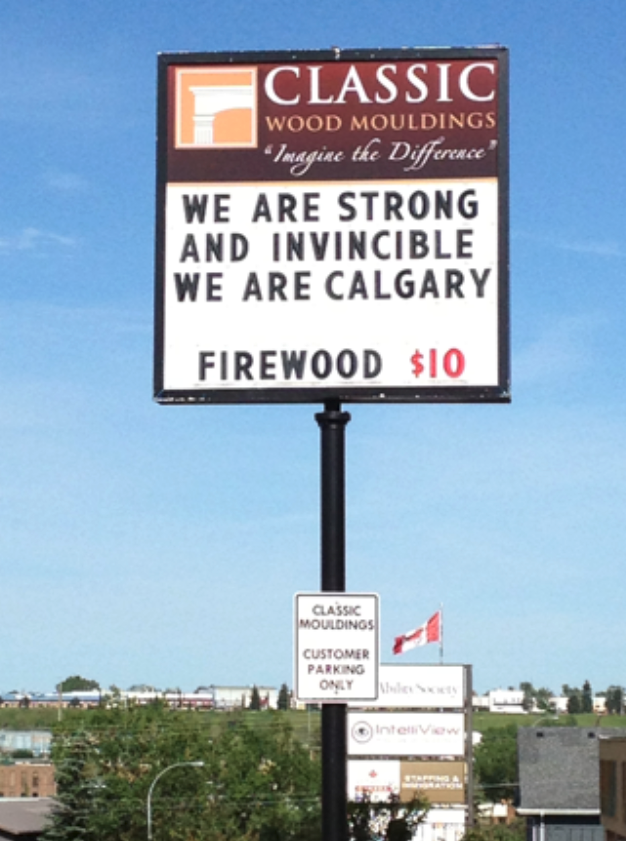
You Can’t Help God (Psalm 50:7-13)
I came across this sign in northeast Calgary after the flood in June of 2013 …
Asaph was a Levite that King David appointed as the chief musician (see 1 Chronicles 16:4-5) in the nation and who also wrote Psalms 73 to 83. He wrote more Psalms than anyone except David. Asaph wrote Psalm 50 to teach God’s people about relationship with the Lord and with people, calling them to worship from the heart and to treat others in ways that honour the One they worship.
The Israelites were bringing bulls and goats to sacrifice to the Lord, offering them as worship and believing they were doing their “religious duty”. It was as if they were paying their “spiritual bill” to God then carrying on with their lives as they pleased, ignoring the Lord the other six days of the week while they mistreated other people. This was the approach of those who worshipped other gods, who supposedly thrived on these animal sacrifices.
Even this little boy demonstrated more faith when he wrote this note: “Dear God: I think about you sometimes, even when I'm not praying.”
God called Asaph to remind the Israelites and us that God does not need our sacrifices – whether they are bulls, goats, time or money. In fact, He owns them all! Every animal in the forest and the cattle on a thousand hills are all His. Since God has neither a beginning nor an end you could say that He has all the time in the world. Neither Bill Gates nor Warren Buffett will take their money with them when they die because they aren’t the ones who ultimately own their riches. God lacks nothing. Craves nothing. He has everything He needs in Himself.
Paul reminds us in Romans 11:35, "Who has ever given to God, that God should repay him?" NIV
God does not owe us a comfortable, trouble-free life because we have been good. If we see God as someone who is in need then we conclude that we are doing Him a favour by doing good things or by being generous. By supporting charities and by helping people who are less fortunate than ourselves we feel that any debt we might owe God is repaid – if not fully at least partially.
When Martin Luther composed his 95 theses in 1517 he was, amongst other things, objecting to church donors trying to buy their deceased loved ones out of purgatory. Well-meaning individuals were inadvertently helping to build St. Peter’s Basilica while believing that God’s wrath was being appeased. But wait! Don’t think for a moment that the Roman Catholic Church has the monopoly on this idea of indulgences, for Protestants and non-churchgoers alike often go about their lives believing that God is in need of our help
Embracing the notion that God needs our help leads to the belief that our good works and generosity will determine our eternal destiny – a doctrine that permeates our culture in obvious and subtle ways. There was a time, for example, when Europeans and North Americans believed that church attendance put us on God’s good side. Now we live in a society dominated by secular humanism so we believe that by being a good person we will secure a more desirable afterlife (if there is one).
Paul Chappell concluded:
God does not need your money; He wants what it represents - you. Finances are God’s gift to you to fulfill His will for your life. While God desires you to prioritize His work in giving, He wants you to purpose to follow and serve Him no matter what happens with your finances.
In Psalm 50:7 God speaks prophetically through Asaph when He declares, “You are my people and I am your God.” Don’t miss the significance of this statement, because even 3,000 years ago the Lord was explaining that eternal life and righteousness flow out of relationship with Him. It is not about doing things for God or giving things to God because we owe it to Him. Actually, we don’t have a hope of ever repaying the debt we owe Him.
We begin to catch a glimpse of why it is so difficult for “good” people to come to
Jesus Christ and to accept Him as their Lord and Saviour. This self-righteousness is at the core of the conflict that Jesus had with the religious leaders 2,000 years ago.
Listen and watch in Matthew 9:9-13:
9 As Jesus went on from there, he saw a man named Matthew sitting at the tax collector's booth. "Follow me," he told him, and Matthew got up and followed him. 10 While Jesus was having dinner at Matthew's house, many tax collectors and "sinners" came and ate with him and his disciples. 11 When the Pharisees saw this, they asked his disciples, "Why does your teacher eat with tax collectors and 'sinners'?" 12 On hearing this, Jesus said, "It is not the healthy who need a doctor, but the sick. 13 But go and learn what this means: 'I desire mercy, not sacrifice.' For I have not come to call the righteous, but sinners." NIV
While Matthew and his colleagues were despised for collecting unfair taxes from their Jewish countrymen on behalf of the Roman Empire, Jesus dared to seek them out and invite them to follow Him. The Pharisees had developed their own ways and means of building up treasures in heaven, adding their traditions to the Word of God and leaving them with no felt need of the Messiah who was standing there staring them in the face. They missed the Messiah because they believed it was God – not them – who needed the help!
Realizing that God does not need your help can change your life. No amount of donating your time, energy and money to the church or other worthwhile causes will make up for the “big” or “little” sins you have committed. God did not create you or me for relationship with Him because He is lonely. God did not give you your job or keep you from financial ruin because He needs you to give Him 10% so He can pay His bills. God, in fact, owns everything already! When we come to grips with this giving and serving then become a privilege rather than an obligation.
When you talk about “your favourite shirt” or “your favourite dress”, do you really think you own it or do you acknowledge that the Lord owns it and He just lets you wear it? When you give of your time, energy and money do you think that God must really be grateful for your help?
You honour God when you recognize that: You Can’t Help God (Psalm 50:7-13)
God Wants to Help You (Psalm 50:14-15)
God isn’t saying in Psalm 50:14 that He was displeased with the sacrifices that were being offered to Him. His people were following the Letter of the Law by offering them but they were overlooking the Spirit of the Law. This worship from the heart is the difference between religion and relationship. It is not that the sacrifices being offered were bad but they were inadequate when they did not come from the heart, from an attitude of gratitude and obedience.
The word “vow” has come to be misunderstood and undervalued today. In an age when promises, New Year’s Resolutions and contracts are made to be broken and a handshake is merely a sign of politeness, vows come across as out-dated and meaningless. The word “vow” is used 42 times in the New International Version Bible and it represents a pledge to action. To fulfill a vow is to act on what you say - to make your actions line up with your words. Let your “yes” be “yes” and your “no” be “no”. Say what you mean and mean what you say. The failure to do so is hypocrisy and this is a stench in God’s nostrils. Let it be known that the Lord despises hypocrisy more than anyone!
At least 25 years before Asaph wrote Psalm 50 King Saul tried to justify his disobedience to God when we come to 1 Samuel 15:22-23:
22 But Samuel replied: "Does the Lord delight in burnt offerings and sacrifices as much as in obeying the voice of the Lord? To obey is better than sacrifice, and to heed is better than the fat of rams. 23 For rebellion is like the sin of divination, and arrogance like the evil of idolatry.
Because you have rejected the word of the Lord, he has rejected you as king." NIV
The steps in Psalm 50:14-15 provide the turning point: we are called from self-reliance to God-reliance. Thanksgiving, obedience, prayer and true worship mark such a transformation. The Bible calls this change of mind “repentance” and it represents a totally new and different approach to life. Rather than trying to earn God’s approval by helping Him we come to realize that God wants to help us. This begins with acknowledging that we need His help even to have a relationship with Him. It continues with relying upon Him to live His holy and righteous life through us – even in the midst of difficult times.
I have a question for you: Why do banks charge a fee on “insufficient funds” when they know there is not enough?
This changes everything when it comes to what is in our bank account and in our home. No longer do we consider ourselves to be the owners but we recognize that God is the owner and we are simply the stewards or managers of what He has entrusted to us. This means we are responsible to Him for how we handle whomever and whatever is under our care. His desires then become our desires and His priorities our priorities.
John Piper explains it this way:
The person who thinks the money he makes is meant mainly to increase his comforts on earth is a fool, Jesus says. Wise people know that all their money belongs to God and should be used to show that God, and not money, is their treasure, their comfort, their joy, and their security.
It goes against our independent nature, but fruitfulness and fulfillment are found when we wholeheartedly declare Psalm 46:1, “God is our refuge and strength, an ever-present help in trouble.” NIV
When was the last time you asked God to help you? Is this a prayer you save for the really big challenges or is this a prayer you offer daily?
Evangelist and pastor Greg Laurie tells the story about an older lady who was determined to be prepared if someday she felt threatened. Then one day she finished shopping and returned to her car. She found four men inside the car. She dropped her shopping bags, drew her handgun, and screamed, "I have a gun, and I know how to use it! Get out of the car." The men got out and ran like crazy
Somewhat shaken, she loaded her bags and got in the car. But she could not get her key into the ignition. Then it dawned on her: her similar car was parked four or five spaces away! So she did what she had to do. She loaded her bags into her own car and drove to the police station to turn herself in.
The desk sergeant nearly fell off his chair laughing. He pointed to the other end of the counter, where four men were reporting a carjacking by an old woman with thick glasses and curly white hair, less than five feet tall, and carrying a large handgun. No charges were filed.
You see, she thought it was her car, but it really belonged to someone else. Sometimes we get all bent out of shape trying to keep and defend what we think is ours. People ruin their lives over defending their financial rights, squabbling over an inheritance and suing people they think cheated them. We think we are someone special when we donate to charities or help someone in need. But God is calling us to think differently – to be stewards – to just faithfully manage what He gives us.
You honour God when you recognize that:
You Can’t Help God
God Wants to Help You
Settle in your mind once and for all that God owns it all.