
The Three-Legged Stool of Stewardship
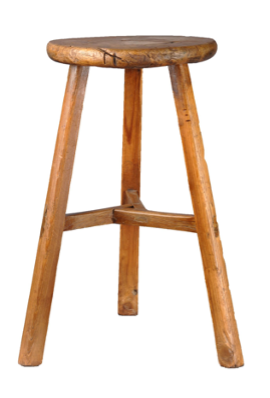
Text: 2 Corinthians 9:6-11
Theme: We honour the Lord by growing, sharing and enjoying what He has entrusted to us.
Application/Purpose: We honour the Lord by growing, sharing and enjoying what He has entrusted to us.
Here’s a thought: John Bunyan advised, “You have not lived today until you have done something for someone who can never repay you.”
Several years ago, I felt the Lord tell me to do three things with what He had entrusted to me to steward. I have found these three things in the Bible invaluable for establishing priorities.
The Apostle Paul had visited the city of Corinth three times, planted the church there, and, according to Acts 18:11, stayed for 18 months, teaching them the word of God. He knew them well, and they knew him well. When Paul arrived in 51 A.D., Corinth was well established as a Roman colony, five times the size of Athens and the capital of the province. Its strategic location made it a hub of trade between the East and the West.
Nelson’s New Illustrated Bible Dictionary provides some background:
Always a commercial and trade centre, Corinth was already prosperous and famous for its bronze, pottery, and shipbuilding more than 800 years before Christ. The Greek poet Homer mentioned “wealthy Corinth” in 850 B.C.
In the following centuries Corinth competed for power with Athens, its stronger neighbour across the isthmus [a narrow strip of land that connects two larger landmasses and separates two bodies of water] to the north. And in 146 B.C. invading Roman armies destroyed Corinth, killing the men and enslaving the women and children. Only a token settlement remained until 44 B.C., when Julius Caesar ordered the city rebuilt. Not only did he restore it as the capital city of the Roman province of Achaia; he also repopulated it with freed Italians and slaves from every nation. Soon the merchants flocked back to Corinth, too.
The city soon became a melting pot for the approximately 500,000 people who lived there at the time of Paul’s arrival. Merchants and sailors, anxious to work the docks, migrated to Corinth. Professional gamblers and athletes, betting on the Isthmian games [an athletic competition that was held every 2 years], took up residence. Slaves, sometimes freed but with no place to go, roamed the streets day and night. And prostitutes (both male and female) were abundant. People from Rome, the rest of Greece, Egypt, Asia Minor - indeed, all of the Mediterranean world - relished the lack of standards and freedom of thought that prevailed in the city.
These were the people who eventually made up the Corinthian church. They had to learn to live together in harmony, although their national, social, economic, and religious backgrounds were very different.
In the outlying areas around Corinth, farmers tended their grain fields, vineyards, and olive groves. But the pulse of Corinth was the city itself, enclosed by walls ten kilometres (six miles) in circumference.
I get the impression the money flowed freely, and lives were lived loosely in Corinth. Paul had asked the church in Corinth to help provide relief to poor followers of Jesus in Judea. The church had promised its support, and it was time for them to follow through.
Paul sent a letter with Titus, and we jump in at 2 Corinthians 9:6-11:
6 Remember this: Whoever sows sparingly will also reap sparingly, and whoever sows generously will also reap generously. 7 Each man should give what he has decided in his heart to give, not reluctantly or under compulsion, for God loves a cheerful giver. 8 And God is able to make all grace abound to you, so that in all things at all times, having all that you need, you will abound in every good work. 9 As it is written: “He has scattered abroad his gifts to the poor; his righteousness endures forever.” 10 Now he who supplies seed to the sower and bread for food will also supply and increase your store of seed and will enlarge the harvest of your righteousness. 11 You will be made rich in every way so that you can be generous on every occasion, and through us your generosity will result in thanksgiving to God. NIV
The three legs of the stewardship stool are:
Grow It
Share It
Enjoy It
Grow It
Paul says in 2 Corinthians 9:6, “Remember this: Whoever sows sparingly will also reap sparingly, and whoever sows generously will also reap generously.” He also says in verse 10, “Now he who supplies seed to the sower …” NIV
There were farmers around Corinth, so even though it was a large city, the people would know something about this cycle of sowing and reaping. This theme of planting and harvesting occurs throughout the Bible and applies in so many ways – here on earth and for eternity. I would like to focus on two resources that the Lord entrusts to us: time and money.
While we are talking about growth, I have a question. What do you call a growth on a drug dealer? A pharma-cyst.
Time and money can be sown like seed in the ground for agricultural growth or invested in business or people for financial and spiritual growth. We can spend our time on what we enjoy today or invest it in personal, professional, and/or academic growth for tomorrow. We can spend our money now or invest it in ways that harness the power of compound interest, growing exponentially over time. We have this multi-faceted relationship with the Lord, who loves us unconditionally yet holds us accountable to grow what He has placed under our management.
Jesus’ parable of the talents in Matthew 25:14-30 reveals His desire for us to grow our time and money. He talks about a man who gave three different sums of money to three different servants before he went away on a long journey. After a long time, he returned and called his three servants to account. Two of the servants put their master’s money to work and doubled his investment. The man declared to each of them, “Well done, good and faithful servant!” He went on to give them more privileges and responsibilities.
The third servant, however, was filled with fear and simply hid the money that his master left with him. The man was very angry, threw him out of the house and gave his unfaithful servant’s money to the one who already had his master’s trust and the most resources. Wait a minute! This doesn’t seem fair! Who are we to say what is fair? We would be exceedingly, eternally wise to know and apply this principle of the King and His kingdom: He wants us to sow, grow and invest the time and money He has entrusted to us.
We can grow our money through business, agriculture, real estate, the stock market, mutual funds, and other avenues. We can grow and multiply our time by investing in people. Paul was nearing the end of his life when he advised his young apprentice, Timothy, in 2 Timothy 2:2, “And the things you have heard me say in the presence of many witnesses entrust to reliable men who will also be qualified to teach others.” NIV
I invest time and money in my growth. Do you? I am looking for ways to invest my master’s money. Are you? If you need help knowing how to do this, let me know. I am looking for people I should invest time in. I am looking for people who live or who want to live eternally productive lives. Are you one of them? If you would like to be, let me know by what you say and do.
Grow It
Share It
Paul teaches in 2 Corinthians 9:7, “Each man should give what he has decided in his heart to give, not reluctantly or under compulsion, for God loves a cheerful giver.” He goes on in verse 11, “You will be made rich in every way so that you can be generous on every occasion, and through us your generosity will result in thanksgiving to God.” NIV
If we stopped with the first leg of the stool – grow it – we would pursue self-centred lives in which we could never seem to accumulate enough. We would be like the man in Jesus’ parable of the rich fool in Luke 12:13-21, who tore down his barns and built bigger ones so he could hoard his riches. Sadly, he died suddenly without realizing how eternally important it is to be rich toward God. It was too late
In contrast, Jesus pointed out to His disciples the poor widow who gave generously in Mark 12:41-44. Even though the wealthy people gave large amounts in the temple offering that day, Jesus pointed out that she gave less than a penny but more than all the others. Studies continue to show that poor people tend to give away a higher proportion of their income than the rich.
John Bunyan (1628-1688) advised, “You have not lived today until you have done something for someone who can never repay you.”
Why does the Lord bless us with time and money? One reason is so that we can be generous to His work and with those in need. This cultivates an attitude of gratitude, peace and trust as we look beyond ourselves to what the Lord is doing in the world and for those who are struggling. This outward view brings joy, contentment and fulfillment.
While we are called to grow our time by investing in reliable, productive people and our money by investing in reliable, productive businesses, we are also called to give without expecting anything in return. The Lord will set up opportunities for us to give time to people who may or may not thank us. He will lead us to people and causes that won’t even provide us with tax receipts for our donations. When we do this cheerfully, joyfully or graciously (the Greek word here in 2 Corinthians 9:7 is hilaron or hilaros, from which we get the English word hilarious), we bring our Lord pleasure. God loves a cheerful giver!
How and with whom can you share your time and money? The God who gives loves to answer this prayer when you ask Him.
Grow It
Share It
Enjoy It
Paul says 2 Corinthians 9:10, “Now he who supplies seed to the sower and bread for food ...”
While seed is for sowing, planting or investing, bread is for eating. It speaks most often of provision. BibleStudy.org explains:
There are at least seven words referencing bread in the Hebrew language version of the Old Testament and three Greek words referring to it in the New Testament. Mentioned at least 492 times in the original languages of the Bible, it is easy to see how important bread was to everyday life. In Bible times (for most people in and near Israel), bread was a part of a basic diet that included vegetables, fruit, olives and cheese (from www.biblestudy.org/bible-study-by-topic/bread-in-the-bible.html).
The Lord knows that we need food to survive. In fact, He teaches us to pray in Matthew 6:11, “Give us this day our daily bread.” KJV Whether our “bread” has gluten or not, we all need it to survive.
Paul writes to Timothy in 1 Timothy 6:17-19:
17 Command those who are rich in this present world not to be arrogant nor to put their hope in wealth, which is so uncertain, but to put their hope in God, who richly provides us with everything for our enjoyment. 18 Command them to do good, to be rich in good deeds, and to be generous and willing to share. 19 In this way they will lay up treasure for themselves as a firm foundation for the coming age, so that they may take hold of the life that is truly life. NIV
While we tend to focus on what he says about riches and laying up for ourselves treasure for the coming age, we should not miss what Paul says at the end of verse 17, “God, who richly provides us with everything for our enjoyment or pleasure.” God actually wants us to enjoy what He provides for us!
Hey, animals have fun too! Why are theatres popular among cows? They enjoy watching moovies.
Bread, or food, is not just necessary; it is enjoyable. John UpChurch writes in “Taste & See” (https://answersingenesis.org/biology/taste-see):
Just open up and say, “Ah!” Right there on your tongue, you’ll find a conglomeration of thousands of pieces of evidence that God cares about you having a mouthful of yum. Those small structures, called papillae (puh-PILL-ee) contain taste buds where your taste receptor cells live. They come in a variety of shapes and sizes, looking something like a coral reef under the microscope. Each receptor helps you enjoy different tastes. Behind those receptors is a nervous system that processes this medley of information and makes sure we extract every ounce of pleasure possible from each morsel.
The Lord provides us with time and money to sustain us. He also gives us time and money to enjoy. This is the beauty and the balance of the three-legged stool. If we focused on growing what we have, we would eventually explode. If we focused on sharing what we have, we would soon have nothing. If we focused on enjoying what we have, we would, sooner or later, exhaust our supply of time and money. Let us enjoy - in balance with the other two legs of the stool - what the Lord has given to us.
Life provides many opportunities for us to enjoy the “bread” that the Lord provides. We should do so – with thanksgiving and without guilt.
The cameras in the room here sit on tripods or three-legged stools. Why do these have three legs rather than four?
A three-legged stool is a wonder of physics. It is more stable than a four-legged stool and can sit stably on an uneven surface, as the ends of the three legs are always in the same geometric plane. Most stools have legs that are angled slightly outward. This creates friction in three opposing directions, which enhances stability. A well-designed three-legged stool also positions each leg equidistant from the other two, creating a “perfect triangle”. The stool will become increasingly less stable if one leg is pulled closer to another, as it changes the weight distribution and the inherent balance and tension amongst the legs that created the stability (www.paretocaptive.com/analogies3.php).
In an uneven, unstable world, the three legs of the stewardship stool are:
Grow It
Share It
Enjoy It
We honour the Lord by growing, sharing and enjoying what He has entrusted to us.