
Life Of Faith | Faith Series | Week 5
Series: Faith | Week 5
Text: Genesis 11:27-12:9 and Hebrews 11:8-10
Faith begins with God speaking and ends with you obeying.
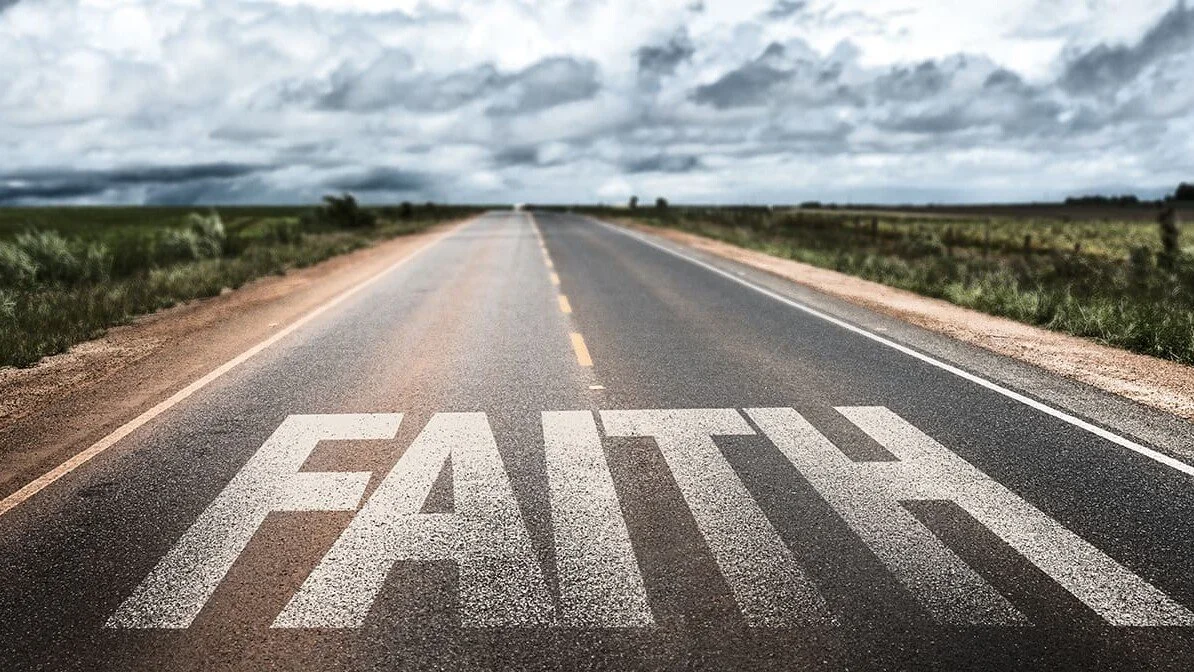
Abraham’s story shows that genuine faith always begins with God taking the initiative—speaking, calling, and shaping a vision far bigger than our own comfort or familiarity. His journey out of Ur reminds us that the life of faith often unfolds without a map, sustained by a clear, God-given picture of a future we cannot yet see. Hebrews 11 highlights this forward-looking posture: Abraham lived in tents because his eyes were fixed on a city with foundations, crafted by God Himself. That same dynamic still governs every believer’s walk today—hearing the Lord, holding His vision, and responding in costly obedience.
Here’s a thought: If I will not allow the Lord to lead me anywhere, anytime to do anything then He is not truly my Lord.
Sherlock Holmes and Dr. Watson went on a camping trip. As they lay down for the night Holmes said, "Watson, look up into the sky and tell me what you see."
Watson replied, "I see millions and millions of stars." Holmes: "And what does that tell you?"
Watson: "Astronomically, it tells me that there are millions of galaxies and potentially billions of planets. Theologically, it tells me that God is great and that we are small and insignificant. Meteorologically, it tells me that we will have a beautiful day tomorrow. What does it tell you?"
Holmes: "Somebody stole our tent."
I want to talk about a man who spent a significant part of his time living in tents (you might say he was “in tents”) in Genesis 11:27-12:9:
27 This is the account of Terah. Terah became the father of Abram, Nahor and Haran. And Haran became the father of Lot. 28 While his father Terah was still alive, Haran died in Ur of the Chaldeans, in the land of his birth. 29 Abram and Nahor both married. The name of Abram's wife was Sarai, and the name of Nahor's wife was Milcah; she was the daughter of Haran, the father of both Milcah and Iscah. 30 Now Sarai was barren; she had no children. 31 Terah took his son Abram, his grandson Lot son of Haran, and his daughter-in-law Sarai, the wife of his son Abram, and together they set out from Ur of the Chaldeans to go to Canaan. But when they came to Haran, they settled there. 32 Terah lived 205 years, and he died in Haran. 12:1 The Lord had said to Abram, "Leave your country, your people and your father's household and go to the land I will show you. 2 "I will make you into a great nation and I will bless you; I will make your name great, and you will be a blessing. 3 I will bless those who bless you, and whoever curses you I will curse; and all peoples on earth will be blessed through you." 4 So Abram left, as the Lord had told him; and Lot went with him. Abram was seventy-five years old when he set out from Haran. 5 He took his wife Sarai, his nephew Lot, all the possessions they had accumulated and the people they had acquired in Haran, and they set out for the land of Canaan, and they arrived there. 6 Abram traveled through the land as far as the site of the great tree of Moreh at Shechem. At that time the Canaanites were in the land. 7 The Lord appeared to Abram and said, "To your offspring I will give this land." So he built an altar there to the Lord, who had appeared to him. 8 From there he went on toward the hills east of Bethel and pitched his tent, with Bethel on the west and Ai on the east. There he built an altar to the Lord and called on the name of the Lord. 9 Then Abram set out and continued toward the Negev. NIV
Faith includes:
God Speaking Clear Vision Your Obedience
Faith includes:
God Speaking (Genesis 12:1-3)
We are introduced to Abram, later known as Abraham, in Genesis 11:27 and it is noteworthy that he is listed here before his two older brothers, Nahor and Haran. There was something special about this man Abram. Ur of the Chaldeans was Abram’s home city. Today, Ur is in southern Iraq, about 160 kilometres northwest of the Kuwait border. As a centre of economic and political power, Ur was capital of the ancient Chaldean Empire in ancient Mesopotamia and one of the greatest cities of the ancient world. Sometime around 1900 B.C. The Lord told Abram to leave his home and country and go to a land that the Lord would show Abram. He obeyed and left Ur with his father Terah and his nephew Lot.
They travelled as far as 1,000 kilometres northwest and this was not by air or highway! Haran (not to be confused with Abram’s brother and in modern-day Turkey) in Mesopotamia was Abram’s first stopping place recorded in the Bible. They dwelt here for a number of years until after the death of his father Terah, and in Haran the Lord called Abraham again – this time with more detail.
Abram was in Haran at age 75 when he got the call from God to leave his home and family behind and follow God into a strange land that He would give him. Time quoted Thomas Cahill, author of The Gifts of the Jews, calling the move "a complete departure from everything that has gone before in the evolution of culture and sensibility." Abram took his wife, his nephew, Lot, and his possessions and departed. Abram moved south into the land of Canaan, a land inhabited by a warrior people called the Canaanites. He settled temporarily in Shechem and Beth-el. God told Abraham his descendants would inherit the Canaanite land.
The Apostle Paul explains that faith comes from hearing God’s voice in Romans 10:14-17:
14 How, then, can they call on the one they have not believed in? And how can they believe in the one of whom they have not heard? And how can they hear without someone preaching to them? 15 And how can they preach unless they are sent? As it is written, "How beautiful are the feet of those who bring good news!" 16 But not all the Israelites accepted the good news. For Isaiah says, "Lord, who has believed our message?" 17 Consequently, faith comes from hearing the message, and the message is heard through the word of Christ. NIV
We are exhorted throughout Scripture and by many preachers today to have faith. Faith is vitally important and I do not mean to downplay its importance.
What I mean to clarify, however, is that faith based upon our own ideas and our own effort is actually presumption. There is a difference between faith in God and the faith of God. Faith of God arises when we hear His voice and receive His faith.
How do I describe what God’s voice sounds like? It sounds like a frustrating, circular answer but you need to learn to hear God’s voice for yourself. How would I describe the voice of my father? I would show you a video and let you hear his voice for yourself. I cannot do that with God’s voice. He rarely speaks audibly but He certainly speaks! What He says will never contradict His written Word, the Bible.
Do you get impressions, urges, dreams, visions and/or images in your head that leave you wondering if the Lord is speaking to you? If yes, it is time to start weighing these with Scripture and with godly counsel. Perhaps the Lord is trying to get your attention.
Faith includes:
God Speaking (Genesis 12:1-3)
Clear Vision (Hebrews 11:8-10)
Abram is listed in the Hall of Faith in Hebrews 11:8-10:
8 By faith Abraham, when called to go to a place he would later receive as his inheritance, obeyed and went, even though he did not know where he was going. 9 By faith he made his home in the promised land like a stranger in a foreign country; he lived in tents, as did Isaac and Jacob, who were heirs with him of the same promise. 10 For he was looking forward to the city with foundations, whose architect and builder is God. NIV
What motivated Abram to do what he did? He had a clear vision of the hereafter. As a city boy living in tents he looked beyond his life here on earth to the heavenly city, which the Bible describes (in Revelation 21) as The New Jerusalem. Much to every woman’s surprise, men like to know where they are going.
Two tourists were driving through Nova Scotia. As they were approaching Shubenacadie (shoe-bin-aack-ad-dee), they started arguing about the pronunciation of the town's name. They argued back and forth until they stopped for lunch. As they stood at the counter, one tourist asked the employee, "Before we order, could you please settle an argument for us? Would you please pronounce where we are ... ver-r-ry slo-o-owly?"
The waitress leaned over the counter and replied, "Tiiimmmmm Hoorrrrttoooonnns."
Abram set out with no GPS or Google Maps app on his iPhone. He had no clue where the Lord was leading him!
Some people actually enjoy being a stranger and actually enjoy meeting new people, but many do everything humanly possible to avoid such uncomfortable moments. What would our lives be like and what would we miss if we never ventured beyond our comfort zone?
Oscar Wilde (1854-1900) observed, "To live is the rarest thing in the world. Most people exist, that is all."
A clear vision makes all the difference. What is God’s vision for your life? If you know the answer to this question, how does this vision shape your priorities and the way you live each day? If you do not know the answer to this question, how do you plan to find out? Surrendering yourself to Him, reading of God’s vision in His Word, embracing your God-given gifts, praying and listening to Him and to godly counsel will all be instrumental in finding the answer.
Faith includes:
God Speaking (Genesis 12:1-3) Clear Vision (Hebrews 11:8-10)
Your Obedience (Genesis 12:4-9)
The land of Canaan would be the inheritance of Abram's descendants but Abram would only be a pilgrim there. On his journey to Canaan there were 17 places that Abram visited recorded in the Old Testament. Each of these places are important in the history of Israel and there is evidence of their existence in ancient times through archaeology.
We read these Biblical accounts and we tend to miss the timing of these events in the lives of real people. Ur represented everything that was familiar to Abram. This was well before the Internet and he would not have read National Geographic magazine. Try to imagine how difficult it would have been for him to leave his home!
I have talked to some people who would never entertain the idea of leaving their family and their home town. Beware of closing off the possibilities of God’s leading in your life! Ironically, I am living in the area where I grew up, but not because I planned it this way. For 17 years I lived in other parts of Alberta and I remain open to the Lord calling me elsewhere. If I will not allow the Lord to lead me anywhere, anytime to do anything then He is not truly my Lord.
James 2:14-24 says it this way:
14 What good is it, my brothers, if a man claims to have faith but has no deeds? Can such faith save him? 15 Suppose a brother or sister is without clothes and daily food. 16 If one of you says to him, "Go, I wish you well; keep warm and well fed," but does nothing about his physical needs, what good is it? 17 In the same way, faith by itself, if it is not accompanied by action, is dead. 18 But someone will say, "You have faith; I have deeds." Show me your faith without deeds, and I will show you my faith by what I do. 19 You believe that there is one God. Good! Even the demons believe that — and shudder. 20 You foolish man, do you want evidence that faith without deeds is useless? 21 Was not our ancestor Abraham considered righteous for what he did when he offered his son Isaac on the altar? 22 You see that his faith and his actions were working together, and his faith was made complete by what he did. 23 And the scripture was fulfilled that says, "Abraham believed God, and it was credited to him as righteousness," and he was called God's friend. 24 You see that a person is justified by what he does and not by faith alone. NIV
Are there unfinished assignments from the Lord that you have been ignoring or delaying? You can’t rush God’s work in your life but you can certainly slow it down. Why would He give you more if you have not finished what He has already given you? Are you ready to get serious about obeying God? Make a decision today and tell someone about these assignments so you can make yourself accountable.
Faith includes:
God Speaking Clear Vision Your Obedience
Faith begins with God speaking and ends with you obeying.