
The Handwriting Is On The Wall | The Book of Daniel | Week 6
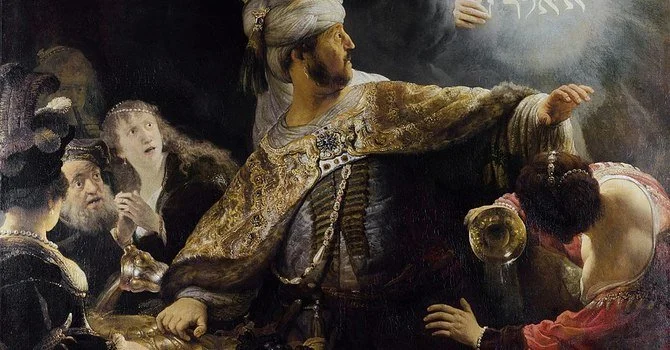
Series: The Book of Daniel | Week 6
Text: Daniel 5:1-31
The Lord wants us to follow His subtle directions.
Belshazzar saw the sign but missed the message. God’s warnings are mercy—lights on the dashboard of the soul. Ignore them long enough and consequences will do the talking. Wisdom listens before it’s too late and learns to honour the God who holds our life in His hand.
Here’s a thought: American politician Adlai Stevenson II observed, “Man is a strange animal; he doesn’t like to read the handwriting on the wall until his back is up against it.”
Brenda and I were a young married couple living in Edmonton, and I was attending what is now called Taylor Seminary in 1989. I was driving my 1976 Dodge Dart Swinger when a red “Check Engine” light grabbed my attention from the dashboard. I took it to our mechanic, and he advised me to replace the sensor or remove the light bulb. We didn’t have much money to replace the sensor, so I simply removed the light bulb.
I didn’t check the oil level regularly, and it had been a while since I changed or added oil. This series of bad choices resulted in a loud knock under the hood and just enough time for me to pull over on the busy Whitemud Freeway as I returned from class on a cold winter day in South Edmonton to our apartment in West Edmonton.
My pride and our bank account took a hit when our mechanic confirmed that the engine had lost enough oil to seize. I learned the hard way to pay attention to the warning lights not only in the dashboard of my car but of my life.
The Lord is speaking. Are we listening? I am learning that God can get our attention through: Confusion (Daniel 5:1-12)
Daniel 5:1-12:
1 King Belshazzar gave a great banquet for a thousand of his nobles and drank wine with them. 2 While Belshazzar was drinking his wine, he gave orders to bring in the gold and silver goblets that Nebuchadnezzar his father had taken from the temple in Jerusalem, so that the king and his nobles, his wives and his concubines might drink from them. 3 So they brought in the gold goblets that had been taken from the temple of God in Jerusalem, and the king and his nobles, his wives and his concubines drank from them. 4 As they drank the wine, they praised the gods of gold and silver, of bronze, iron, wood and stone. 5 Suddenly the fingers of a human hand appeared and wrote on the plaster of the wall, near the lampstand in the royal palace. The king watched the hand as it wrote. 6 His face turned pale and he was so frightened that his knees knocked together and his legs gave way. 7 The king called out for the enchanters, astrologers and diviners to be brought and said to these wise men of Babylon, “Whoever reads this writing and tells me what it means will be clothed in purple and have a gold chain placed around his neck, and he will be made the third highest ruler in the kingdom.” 8 Then all the king’s wise men came in, but they could not read the writing or tell the king what it meant. 9 So King Belshazzar became even more terrified and his face grew more pale. His nobles were baffled. 10 The queen, hearing the voices of the king and his nobles, came into the banquet hall. “O king, live forever!” she said. “Don’t be alarmed! Don’t look so pale! 11 There is a man in your kingdom who has the spirit of the holy gods in him. In the time of your father he was found to have insight and intelligence and wisdom like that of the gods. King Nebuchadnezzar your father - your father the king, I say - appointed him chief of the magicians, enchanters, astrologers and diviners. 12 This man Daniel, whom the king called Belteshazzar, was found to have a keen mind and knowledge and understanding, and also the ability to interpret dreams, explain riddles and solve difficult problems. Call for Daniel, and he will tell you what the writing means.” NIV
The Wiersbe Bible Commentary explains:
The great King Nebuchadnezzar died in 562 B.C. and was succeeded by his son Evil-Merodach, who reigned for only two years. His brother-in-law Neriglissar murdered him in 560, usurped the throne, and ruled for four years. Then a weak puppet ruler (Labashi-Marduk) held the throne for two months, and finally Nabonidus became king and reigned from 556 to 539. Historians believe Nabonidus was married to a daughter of Nebuchadnezzar and was the father of Belshazzar. Nabonidus ruled the Babylonian Empire, but Belshazzar, his son, was coregent and ruled the city of Babylon.
Previous kings were referred to as their fathers even if there were no biological connections, which explains why Nebuchadnezzar is called Belshazzar’s father.
The God of heaven had given King Nebuchadnezzar several opportunities to humble himself, repent and serve the One who rules all of creation.
Unfortunately, he refused and continued in his pride even though he recorded his experiences for those that followed.
The kings from Nebuchadnezzar to Belshazzar could have learned a lot from Daniel and his three friends. Instead, they followed after other gods, and Belshazzar even stooped to drinking from the gold and silver goblets that Nebuchadnezzar had taken from the temple in Jerusalem years earlier. They drank from these cups and recalled how the Jews’ god was defeated and subjected to Marduk and the Babylonian gods. They praised the gods of gold and silver, bronze, iron, wood and stone as they drank the wine. Our modern, secular minds look at war and empires on a human level, measuring military and political power by the sizes of armies and geographical regions. Ancient minds, however, saw the battles of gods in the spiritual realm resulting in victories and defeats in the physical realm. Belshazzar knew that the Medes were advancing through Babylon and marching toward the city, but he and his inner circle turned to their gods for help. While Belshazzar thought they had cut off the right hand of the god of the Jews when they captured Jerusalem and looted the temple, the God of heaven reached into this confusion with his right hand and wrote a message on the large wall where they gathered.
When people say “the handwriting is on the wall,” they probably do not realize this idiom comes from Daniel chapter 5, indicating that something terrible is about to happen. The queen, who was probably Nebuchadnezzar’s daughter and Belshazzar’s mother, believes everything will work out once the message is interpreted. With such optimism, she reminds the king of Daniel, who was a great help to Nebuchadnezzar years earlier.
We are all subject to fatigue, discouragement, confusion and forgetfulness at one time or another. God used the prophet Elijah almost 400 years before Daniel to demonstrate His incredible power to King Ahab, Queen Jezebel and hundreds of false prophets. Jezebel threatened Elijah, and he fled to the wilderness in fear. The Lord encouraged and restored him physically, mentally and spiritually in 1 Kings 19, then the Lord speaks dramatically and subtly in 1 Kings 19:9-13:
9 There he went into a cave and spent the night. And the word of the LORD came to him: “What are you doing here, Elijah?” 10 He replied, “I have been very zealous for the LORD God Almighty. The Israelites have rejected your covenant, broken down your altars, and put your prophets to death with the sword. I am the only one left, and now they are trying to kill me too.” 11 The LORD said, “Go out and stand on the mountain in the presence of the LORD, for the LORD is about to pass by.” Then a great and powerful wind tore the mountains apart and shattered the rocks before the LORD, but the LORD was not in the wind. After the wind there was an earthquake, but the LORD was not in the earthquake. 12 After the earthquake came a fire, but the LORD was not in the fire. And after the fire came a gentle whisper. 13 When Elijah heard it, he pulled his cloak over his face and went out and stood at the mouth of the cave. Then a voice said to him, “What are you doing here, Elijah?” NIV
The King James Version and New King James Version translates this “gentle whisper” in verse 12 as “still small voice.” The Lord brought a powerful wind, an earthquake and a fire then spoke to Elijah with a gentle whisper.
Where do we go in confusing times? Do we rely on human reasoning (a form of idolatry), or do we rely on revelation from the God of heaven? He wants to whisper to us through the Bible, His Holy Spirit and godly counsel.
God can get our attention through:
Confusion
Confrontation (Daniel 5:13-31)
Belshazzar was not in the habit of following follow God’s subtle directions, so he needed an intervention. He took the queen’s advice, and we read in Daniel 5:13-31:
13 So Daniel was brought before the king, and the king said to him, “Are you Daniel, one of the exiles my father the king brought from Judah? 14 I have heard that the spirit of the gods is in you and that you have insight, intelligence and outstanding wisdom. 15 The wise men and enchanters were brought before me to read this writing and tell me what it means, but they could not explain it. 16 Now I have heard that you are able to give interpretations and to solve difficult problems. If you can read this writing and tell me what it means, you will be clothed in purple and have a gold chain placed around your neck, and you will be made the third highest ruler in the kingdom.” 17 Then Daniel answered the king, “You may keep your gifts for yourself and give your rewards to someone else. Nevertheless, I will read the writing for the king and tell him what it means. 18 “O king, the Most High God gave your father Nebuchadnezzar sovereignty and greatness and glory and splendor. 19 Because of the high position he gave him, all the peoples and nations and men of every language dreaded and feared him. Those the king wanted to put to death, he put to death; those he wanted to spare, he spared; those he wanted to promote, he promoted; and those he wanted to humble, he humbled. 20 But when his heart became arrogant and hardened with pride, he was deposed from his royal throne and stripped of his glory. 21 He was driven away from people and given the mind of an animal; he lived with the wild donkeys and ate grass like cattle; and his body was drenched with the dew of heaven, until he acknowledged that the Most High God is sovereign over the kingdoms of men and sets over them anyone he wishes. 22 “But you his son, O Belshazzar, have not humbled yourself, though you knew all this. 23 Instead, you have set yourself up against the Lord of heaven. You had the goblets from his temple brought to you, and you and your nobles, your wives and your concubines drank wine from them. You praised the gods of silver and gold, of bronze, iron, wood and stone, which cannot see or hear or understand. But you did not honor the God who holds in his hand your life and all your ways. 24 Therefore he sent the hand that wrote the inscription. 25 “This is the inscription that was written: MENE, MENE, TEKEL, PARSIN 26 “This is what these words mean: Mene: God has numbered the days of your reign and brought it to an end. 27 Tekel: You have been weighed on the scales and found wanting. 28 Peres: Your kingdom is divided and given to the Medes and Persians.” 29 Then at Belshazzar’s command, Daniel was clothed in purple, a gold chain was placed around his neck, and he was proclaimed the third highest ruler in the kingdom. NIV
As Nebuchadnezzar had done years before, Belshazzar asked the wise men and enchanters to interpret the handwriting on the wall, but they could not. Belshazzar should have learned from the lessons that Nebuchadnezzar wrote about in his studies in the “school of hard knocks.” Sadly, each generation thinks they are more intelligent than the previous ones, so they ignore their forefathers and head out to “reinvent the wheel” spiritually and morally.
The Spanish philosopher George Santayana warned in 1905, “Those who do not remember the past are condemned to relive it.”
Daniel was about 80 years old, no longer seen as helpful to King Nabonidus or his son, coregent (vice-king) Belshazzar. Daniel remained close to the Lord, ready to speak His words as a teen and now as an older man. The Babylonians called Daniel Belteshazzar, which meant “Bel (a Babylonian god) protect the king.” However, Daniel continued to live up to the Hebrew meaning of his name, “God is my judge.” Detaching himself from political and material advancement again, he confronts the king directly yet respectfully. Belshazzar did not know Daniel, but Daniel certainly knew Belshazzar!
Daniel spoke and wrote Hebrew and Aramaic. Daniel 2:4b–7:28 was written in Aramaic, while the rest of the book was written in Hebrew. The three words on the wall were written in Aramaic, “mene (numbered), tekel (weighed) and parsin (divided).” They indicated that Belshazzar’s days were numbered and his kingdom would come to an end, that his reign had been weighed and found deficient, and that Babylon would be divided among the Medes and Persians.
American politician Adlai Stevenson II observed, “Man is a strange animal; he doesn’t like to read the handwriting on the wall until his back is up against it.”
King Belshazzar had opportunities to follow the Lord’s subtle directions, but he shunned heaven’s initiatives and went his own way. King David uses vivid word pictures with these words of wisdom in Psalm 32:9 (NIV), “Do not be like the horse or the mule, which have no understanding but must be controlled by bit and bridle or they will not come to you.” His son, King Solomon, later echoes in Proverbs 26:3 (NIV), “A whip for the horse, a halter for the donkey, and a rod for the backs of fools!”
The Lord is the God of second chances and new beginnings, but eventually, time will run out. My New Year’s resolution is to stop procrastinating. But I’ll wait until tomorrow to start.
King Belshazzar had one last chance to repent and turn to God before his world came crashing in. Instead, he ignored Daniel’s request to keep the gifts for himself and give his rewards to someone else. He commanded that Daniel be clothed in purple, have a gold chain placed around his neck, and be proclaimed the third highest ruler in the kingdom - below Belshazzar and his father, Nabonidus. The king focused on the messenger but ignored the message!
Are we open to counsel and input? If yes, do we focus on the messenger or the message?
God can get our attention through:
Confusion Confrontation
Consequences (Daniel 5:30-31)
The chapter closes on King Belshazzar and the Babylonian empire in Daniel 5:30-31:
30 That very night Belshazzar, king of the Babylonians, was slain, 31 and Darius the Mede took over the kingdom, at the age of sixty-two. NIV
Belshazzar’s father, King Nabonidus, was apparently in Arabia when the Medes conquered Babylon. There are different theories, but according to britannica.com:
After a popular rising led by the priests of Marduk, chief god of the city, Nabonidus, who favoured the moon god Sin, made his son Belshazzar coregent and spent much of his reign in Arabia.
Nabonidus returned to Babylon and tried to recapture their territory, but he was captured and exiled.
The handwriting was on the wall for Belshazzar, but he refused to change his ways, and the words of Daniel 5:27 were fulfilled, “Tekel [Tekel can mean weighed or shekel]: You have been weighed on the scales and found wanting.”
The scales of justice are still a symbol of our justice system today. This concept of weighing something in order to judge the fate of the deceased is first seen in ancient Egypt around 2,400 B.C., where people’s hearts are weighed on a scale against a feather.
Consequences might be God’s discipline or judgment, or they might be natural outcomes. I can’t blame God for the consequences if I jumped from the roof of my house. Broken bones will probably result from my choice to defy the law of gravity.
The principle of reaping and sowing is woven throughout the Bible, and the Apostle Paul teaches in Galatians 6:7-8:
7 Do not be deceived: God cannot be mocked. A man reaps what he sows. 8 The one who sows to please his sinful nature, from that nature will reap destruction; the one who sows to please the Spirit, from the Spirit will reap eternal life. NIV
The handwriting on the wall in Daniel chapter 5 reminds us that God is involved in world events, and He is the ultimate judge of all evil. On an individual level, He wants to bring transformation to and through us. Let us learn from King Belshazzar and heed His warnings before it’s too late.
Thankfully, a fellow student’s son had a car much like mine. The engine of his car was fine, but the body of his car was in bad shape. Our financial pain was reduced when we sold my beloved 1976 Dodge Dart Swinger to my friend’s son.
Will we humble ourselves and listen to what the God of heaven has to say? God can get our attention through:
Confusion
Confrontation
Consequences
The Lord wants us to follow His subtle directions.
Watch and listen to “Jeremy Camp - When You Speak (Lyrics)”